Thursday, 18 August 2011

Friday, 12 August 2011
READING: Architecture is a device
'What is the role for architecture in this respect? Can it take an active position on these demands?'
(political, economic, societal)
'It can offer alternatives to current tendencies. It can potentially suggest societal directions by literally constructing thoughts'.
This reading investigates the idea that architecture could be used as a device, or a tool far greater than simply to meet the requirements of space. It leads to the challenge for architects to design to facilitate or criticise technical and social changes.
The reading refers to the specific skills of the profession as visualisation and vision. This is very relevant because the images we allow people to interact with have a very powerful effect which are sometimes understated. A lot of the design of the existing parliament is a display of this... a vision that imposes a sense of power and strength, a reflection of the tensions within the system that it was designed for.
What I will take from this reading is the idea that architecture can be used as a device... to shape ideas, suggest new ways of doing things, and offer alternatives to its users.
Thursday, 11 August 2011
POP UP ARCHITECTURE
Some examples of how the idea of pop-up spaces has been applied to create resource efficient architectural solutions. Could qualities of these studies be applied to consider temporary structures in a parliament that appear that enable pop-up construction when we need them and disassembly when we don’t?
Could we potentially convert empty/ unused spaces into temporary parliamentary spaces?
‘CARAPACE’
Canadian artist: Brian Jungen

This pop-up structure is constructed from waste bins, creating a temporary shelter that can be dissassembled and distributed back into use when it is no longer required.
‘ILLY CAFE’
Push button Container cafe


I had the opportunity to visit this pop-up container cafe at the 2010 Architecture Biennale in Venice. It could be a good idea to draw insight from to develop a form of pop-up parliament for this project.
Video: TED TALK: The shareable future of cities: Alex Steffen

MAIN POINTS RAISED:
City determines the amount of energy we use.
Reweaving the urban fabric we already have.
A shift in ideals from the dream home – dream neighbourhood.
We want access to the capacity of things (turning products into services that we have access to when we want them).
POP UP SPACES: Space turning into services. Is a far more sustainable approach to city living.
APPLICATION:
This talk raises the importance of consideration of how our cities function now and how they will function in the future which is very relevant to our project. There is no point designing a new capital city (or part) which will be discarded as our cities take on a changing approach to sharing space. It will be an important point to address, the idea of services when we need them and the challenge will be how to produce an architectural solution which will allow our cities to tap into the capacity of the space as we need it. Perhaps the idea od pop up spaces could be explored further.. would it be possible to have a pop-up parliament, or pop up elements of a parliament as an architectural solution?
Sunday, 7 August 2011
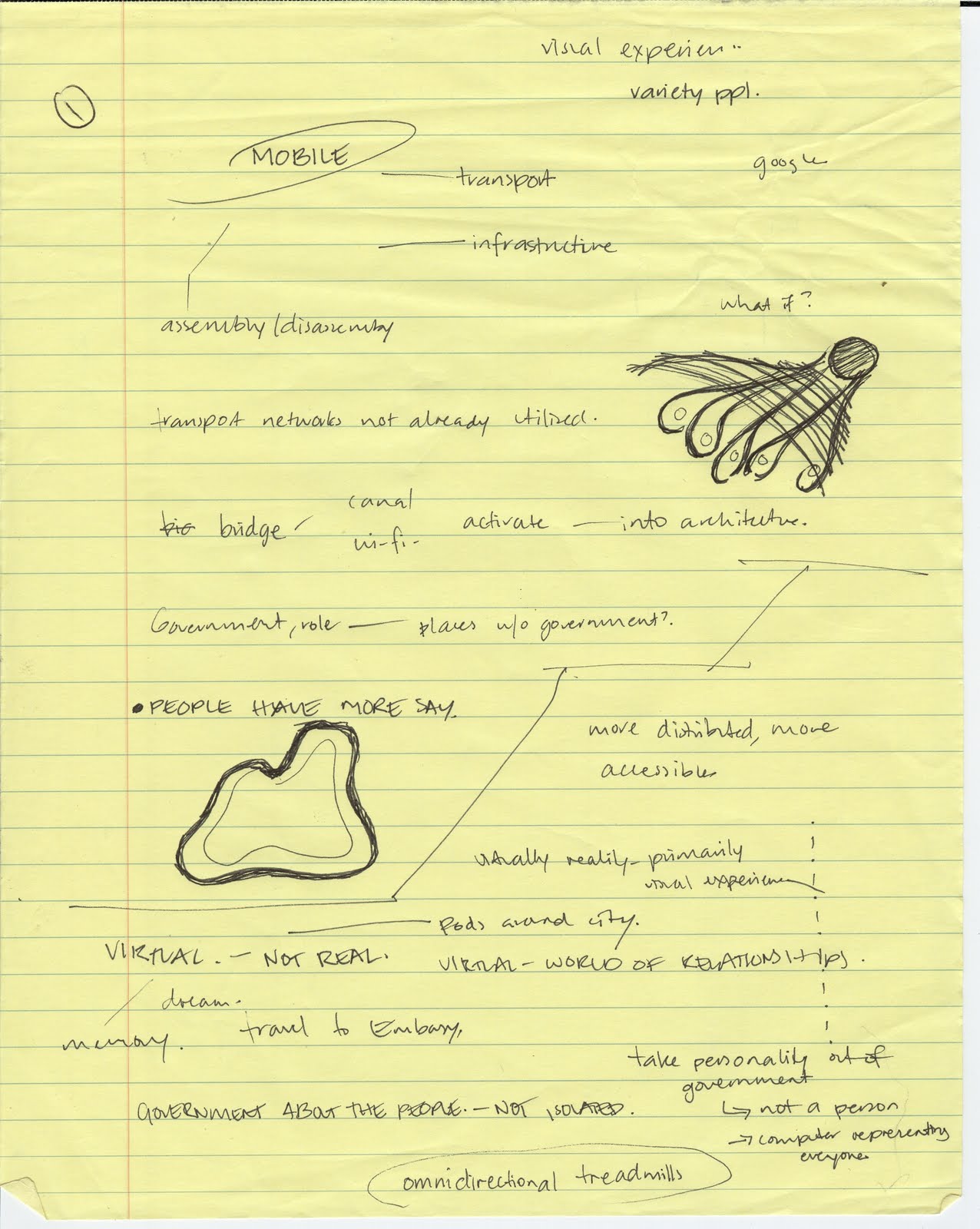


Thursday, 4 August 2011
CANBERRA Capital City of Australia
My first thought when I think of Canberra is that I have no desire to revisit it. I have been there once for a few days and I felt that it had a heavy and slow energy.
What is it about Canberra that lacks life and energy?
For all of its careful design and organised planning, it feels disjointed from the people and the activity of a city life.

One thing that can seen clearly on the plan of Canberra is the formality of the design and the dominance of the the capitol as the central element in the design. The city center itself is located in a separate part of the plan, connected by an axis but otherwise disconnected. Residential suburbs are again planned as separate entities in their own zones. There is very little potential for interaction between the zones within Canberra and very little access without the use of a car. This means that it is very unlikely that people will spontaneously interact with and enjoy the design and architectural elements of the Government zone.
It seems to me that the planners and decision makers of Canberra have attempted to simplify the city for a Government but missed the life and energy found in naturally evolving cities such as Sydney, Melbourne, Brisbane etc. As designers and humans sometimes I think it is natural to get frustrated or overwhelmed by complexity and try to reorganize things to simplify and categorise, but in doing so we disregard the chaotic nature of human beings, and decredit the merit of the complexity and subtlety of the chaos we spontaneously create. I feel like increasingly today we are running around feeling like we have to find a way to transform ourselves into efficient robots to live effectively. It seems that perhaps 100 years ago, people were also feeling this way and trying to over-plan, over-categorise, and over-organise things.
Subscribe to:
Posts (Atom)